


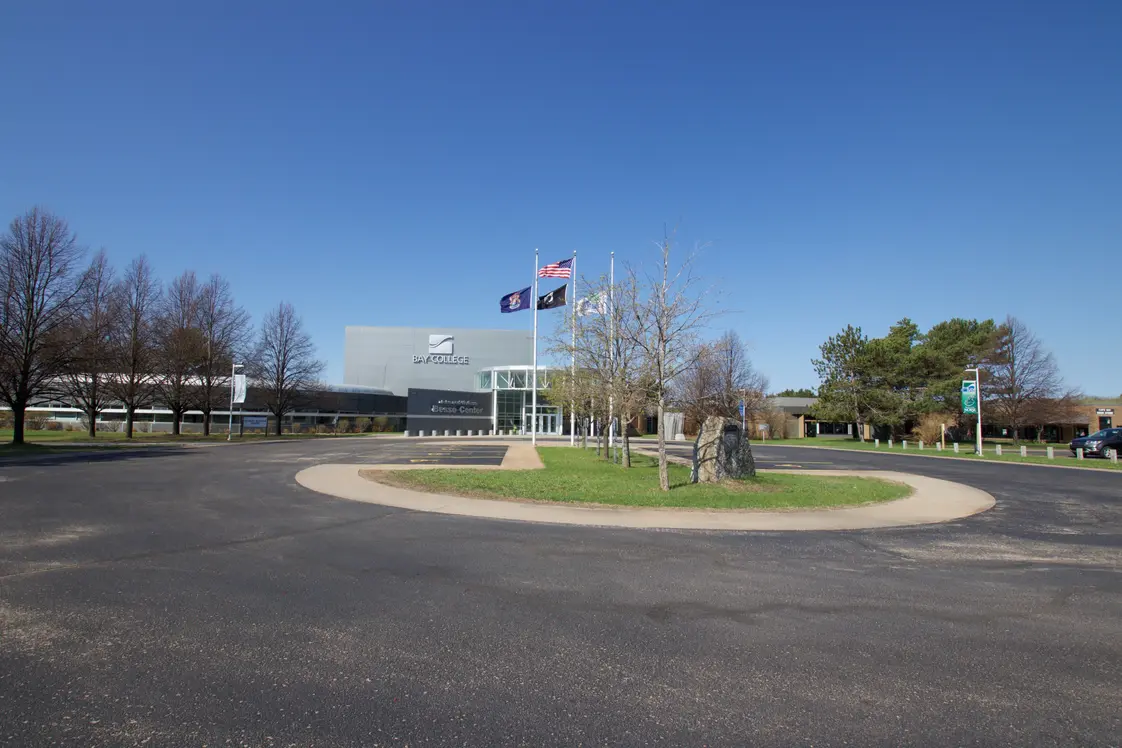


- Located in the heart of Michigan`s beautiful Upper Peninsula, Bay de Noc Community College (or commonly known as Bay College) has provided quality higher education for more than 40 years. Bay College is known in the region for its superior teaching and abundant learning. The campus is situated on 160 acres and services over 5,000 credit students each year, including those completing baccalaureate and master degree programs sponsored by partner universities.
School Highlights
Bay de Noc Community College serves 2,514 students (32% of students are full-time).
The college's student-teacher ratio of 16:1 is lower than the state community college average of 19:1.
Minority enrollment is 14% of the student body (majority Hispanic and American), which is less than the state average of 40%.
Quick Facts (2026)
- Enrollment: 2,514 students
- In-state tuition: $5,300
- Out-state tuition: $9,600
- Student-teacher ratio: 16:1
- Minority enrollment: 14%
- Source: Verified school update
School Overview
The teacher population of 159 teachers has stayed relatively flat over five years.
Bay de Noc Community College
(MI) Community College Avg.
Carnegie Classification
Associate's Colleges: Mixed Transfer/Career & Technical-Mixed Traditional/Nontraditional
Baccalaureate/Associate's Colleges: Associate's Dominant
Institution Level
At least 2 but less than 4 years
At least 2 but less than 4 years
Institution Control
Public
Public
Total Faculty
159 staff
224 staff
School Calendar
Student Body
The student population of Bay de Noc Community College has declined by 7% over five years.
The student-teacher ratio of 16:1 has decreased from 17:1 over five years.
The Bay de Noc Community College diversity score of 0.26 is less than the state average of 0.60. The school's diversity has grown by 16% over five years.
Total Enrollment
2,514 students
3,006 students
Student-Teacher Ratio
16:1
19:1
# Full-Time Students
815 students
904 students
# Part-Time Students
1,699 students
2,102 students
# Enrollment Undergraduate
251 students
219 students
# Full-Time Undergraduate Students
815 students
965 students
# Full-Time Graduate Students
n/a
4 students
# Part-Time Undergraduate Students
1,699 students
2,448 students
# Part-Time Graduate Students
n/a
4 students
Total Dormitory Capacity
100 students
188 students
% American Indian/Alaskan
3%
n/a
% Asian
1%
4%
% Hispanic
3%
7%
% Black
2%
16%
% White
86%
60%
% Hawaiian
n/a
1%
% Two or more races
4%
4%
% Non Resident races
n/a
2%
% Unknown races
1%
6%
Diversity Score
0.26
0.60
College Completion Rate (Students who graduate in less than 4 years)
0.3199%
28%
College Completion Rate (Students who graduate in 4 years or more than 4 years)
n/a
20%
Average Graduate Earnings (10 Years)
$30,700
$28,700
Tuition and Acceptance Rate
The public in-state tuition of $5,300 is less than the state average of $5,506. The in-state tuition has declined by 37% over four years.
The public out-state tuition of $9,600 is more than the state average of $7,381. The out-state tuition has stayed relatively flat over four years.
In-State Tuition Fees
$5,300
$5,506
Out-State Tuition Fees
$9,600
$7,381
Tuition Notes
In-state rate is annual fee for Delta County residents - 2020 tuition rates, for two semesters of 15 contact hours each. Includes tuition and related fees from 2020-2021 Educational Budgets from the financial aid office.
% Students Receiving Some Financial Aid
82%
88%
Median Debt for Graduates
$12,438
$11,704
Median Debt for Dropouts
$5,500
$5,500
Acceptance Rate
n/a
100%
Source: 2024 (or latest year available) Integrated Postsecondary Education Data System (IPEDS) , School Administrators
School Notes
- Bay College has grown from a modest beginning with a limited curriculum in 1963 to serving an enrollment of more than 2,300 students in the fall of 2005. Bay College also opened a new West Campus located in Iron Mountain in the fall of 2007. Partnerships with various four-year schools allow students to continue taking classes on the Escanaba campus and to gain a baccalaureate degree without leaving town. In addition to these partnerships, Bay College continues its traditional occupational programs aimed at giving students the skills to enter the work force, community service, and transfer programs. These transfer programs are designed to allow students to begin their post-secondary education and explore career interests at Bay College, later applying their two-year degree program at a major college or university. Bay College has a strong history of dedicating itself to offering academically excellent and affordable public education in our region. The college prepares students to be continuous learners who succeed upon transfer, work effectively in the contemporary workplace, and function as citizens and leaders in their communities. The College is accredited by the Commission of the North Central Association of Colleges and Schools.
Frequently Asked Questions
How much does Bay de Noc Community College cost?
Bay de Noc Community College's tuition is approximately $5,300 for In-State students and $9,600 for Out-State students.
What schools are Bay de Noc Community College often compared to?
Bay de Noc Community Collegeis often viewed alongside schools like Lansing Community College by visitors of our site.
Nearby Schools
The nearest community college to Bay de Noc Community College is Keweenaw Bay Ojibwa Community College (97.5 miles away)
School
Location
Miles
Quick Facts
111 Beartown Road
Baraga, MI 49908
(906) 524-8400
Baraga, MI 49908
(906) 524-8400
97.5 miles
Enrollment: 302 students Minority enrollment: 62%
Rasmussen University-Wisconsin
Private for-profit
904 South Taylor Street, Suite 100
Green Bay, WI 54303
(920) 593-8400
Green Bay, WI 54303
(920) 593-8400
98.8 miles
Enrollment: 641 students Student-teacher ratio: 10:1 Private-state tuition: $10,764 Minority enrollment: 36%
2740 W Mason St
Green Bay, WI 54307
(920) 498-5400
Green Bay, WI 54307
(920) 498-5400
99.5 miles
Enrollment: 15,271 students Student-teacher ratio: 18:1 In-state tuition: $4,198 Out-state tuition: $6,036 Minority enrollment: 22%
1701 E Front St
Traverse City, MI 49686
(231) 995-1000
Traverse City, MI 49686
(231) 995-1000
100.6 miles
Enrollment: 3,629 students Student-teacher ratio: 8:1 In-state tuition: $5,645 Out-state tuition: $6,994 Minority enrollment: 22%
1515 Howard St
Petoskey, MI 49770
(231) 348-6600
Petoskey, MI 49770
(231) 348-6600
106.7 miles
Enrollment: 2,154 students Student-teacher ratio: 22:1 Acceptance rate: 80% In-state tuition: $5,940 Out-state tuition: $7,710 Minority enrollment: 14%
Recent Articles

Test Article, Image and Content
Test Test Test Test Test Test Test Test Test Test Test Test Test Test Test Test Test Test Test Test Test Test Test Test Test Test Test Test Test Test Test Test Test Test Test Test Test Test Test Test Test Test Test Test Test Test Test Test Test Test Test Test Test Test Test Test Test Test Test Test Test Test Test Test Test Test Test Test Test Test Test Test Test Test Test Test Test Test Test Test Test Test Test Test Test Test Test Test Test Test Test Test Test Test Test Test Test Test Test Test Test Test Test Test Test Test Test Test Test Test Test Test Test Test Test Test Test Test Test Test Test Test Test Test Test Test Test Test Test Test Test Test Test Test Test Test Test Test Test Test Test Test Test Test Test Test Test Test Test Test Test Test Test Test Test Test Test Test Test Test Test Test Test Test Test Test Test Test Test Test Test Test Test Test Test Test Test Test Test Test Test Test Test Test

Faith Formation Integrated Across Subject Areas
Explore faith formation integrated across subject areas and its impact on curriculum, student outcomes, and community colleges.

Parish-Based Governance Models in Catholic Schools
Explore parish-based governance models in Catholic schools and their impact on leadership, funding, and community colleges.