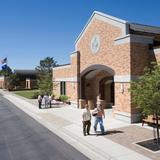
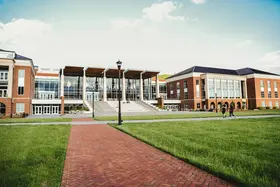
Red Lake Nation College is a public tribal land-grant community college on the Red Lake Indian Reservation in Red Lake, Minnesota. It is fully accredited by the Higher Learning Commission and enrolls about 150 students.
School Highlights
Red Lake Nation College serves 266 students (61% of students are full-time).
Minority enrollment is 98% of the student body (majority American), which is more than the state average of 42%.
Quick Facts (2026)
Enrollment: 266 students
Minority enrollment: 98%
Source: Integrated Postsecondary Education Data System (IPEDS)
Note: Data may not be displayed on any public-facing website or service that replicates or resembles a college search or review portal without prior written permission. See our Terms of Service.
Note: Data may not be displayed on any public-facing website or service that replicates or resembles a college search or review portal without prior written permission. See our Terms of Service.
Note: Data may not be displayed on any public-facing website or service that replicates or resembles a college search or review portal without prior written permission. See our Terms of Service.
Note: Data may not be displayed on any public-facing website or service that replicates or resembles a college search or review portal without prior written permission. See our Terms of Service.
Note: Data may not be displayed on any public-facing website or service that replicates or resembles a college search or review portal without prior written permission. See our Terms of Service.
Note: Data may not be displayed on any public-facing website or service that replicates or resembles a college search or review portal without prior written permission. See our Terms of Service.
Note: Data may not be displayed on any public-facing website or service that replicates or resembles a college search or review portal without prior written permission. See our Terms of Service.
Note: Data may not be displayed on any public-facing website or service that replicates or resembles a college search or review portal without prior written permission. See our Terms of Service.
Note: Data may not be displayed on any public-facing website or service that replicates or resembles a college search or review portal without prior written permission. See our Terms of Service.
College Completion Rate (Students who graduate in less than 4 years)
Note: Data may not be displayed on any public-facing website or service that replicates or resembles a college search or review portal without prior written permission. See our Terms of Service.
College Completion Rate (Students who graduate in 4 years or more than 4 years)
Note: Data may not be displayed on any public-facing website or service that replicates or resembles a college search or review portal without prior written permission. See our Terms of Service.
Median Debt for Graduates
n/a
$12,264
Median Debt for Dropouts
n/a
$6,750
Acceptance Rate
n/a
94%
SAT Reading
n/a
625
SAT Math
n/a
600
SAT Writing
n/a
565
ACT Composite
n/a
24
ACT English
n/a
24
ACT Math
n/a
23
ACT Writing
n/a
8
Source: 2024 (or latest year available) Integrated Postsecondary Education Data System (IPEDS) , School Administrators
Test Test Test Test Test Test Test Test Test Test Test Test Test Test Test Test Test Test Test Test Test Test Test Test Test Test Test Test Test Test Test Test Test Test Test Test Test Test Test Test Test Test Test Test Test Test Test Test Test Test Test Test Test Test Test Test Test Test Test Test Test Test Test Test Test Test Test Test Test Test Test Test Test Test Test Test Test Test Test Test Test Test Test Test Test Test Test Test Test Test Test Test Test Test Test Test Test Test Test Test Test Test Test Test Test Test Test Test Test Test Test Test Test Test Test Test Test Test Test Test Test Test Test Test Test Test Test Test Test Test Test Test Test Test Test Test Test Test Test Test Test Test Test Test Test Test Test Test Test Test Test Test Test Test Test Test Test Test Test Test Test Test Test Test Test Test Test Test Test Test Test Test Test Test Test Test Test Test Test Test Test Test Test Test
For Minnesota public community colleges, the average tuition is approximately $5,489 per year for in-state students and $6,145 for out-of-state students. For private community colleges, the average yearly tuition is approximately $17,300 per year. Read more about average community college tuition costs across the country.